AIAA 2025-2026 Strike Fighter Design Competition
ALEBORNE F-44

FALCON

Next-generation carrier-based strike fighter designed to replace the F/A-18E/F Super Hornet — with twin F119 afterburning turbofans, internal weapons carriage, and advanced survivability for the 2035 carrier air wing.

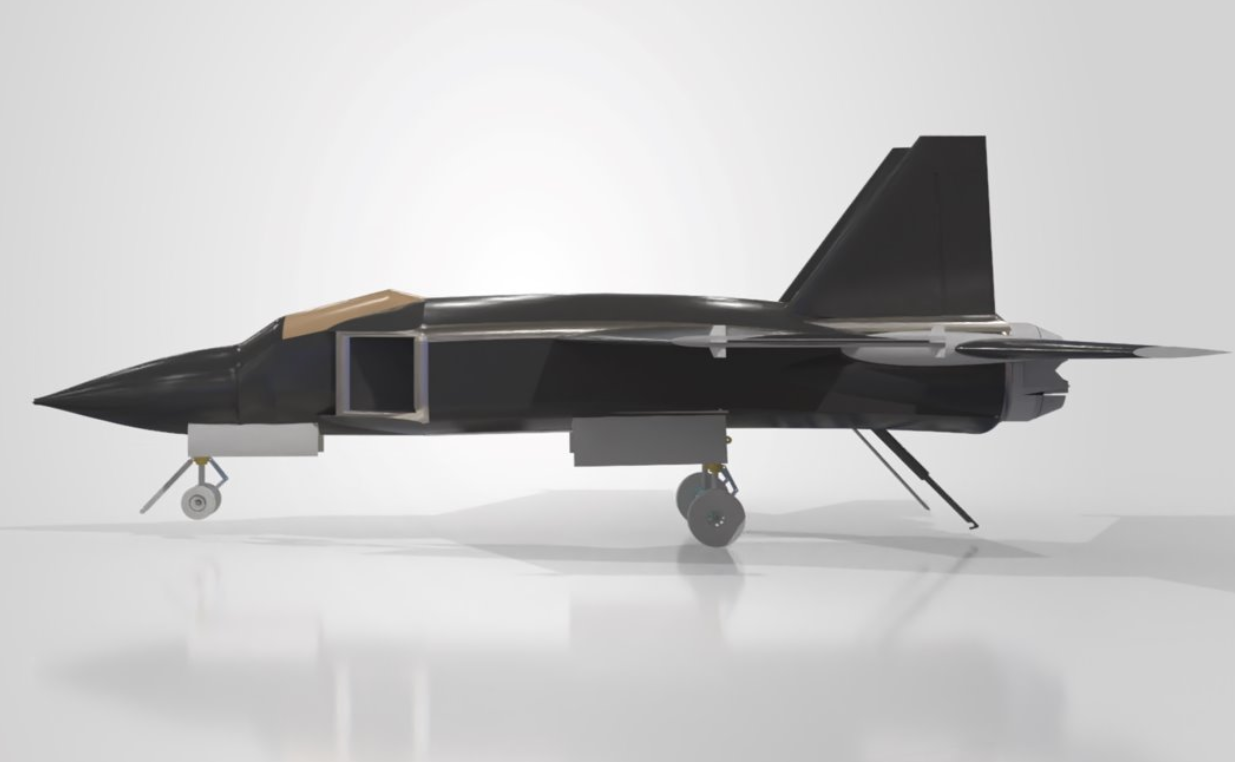
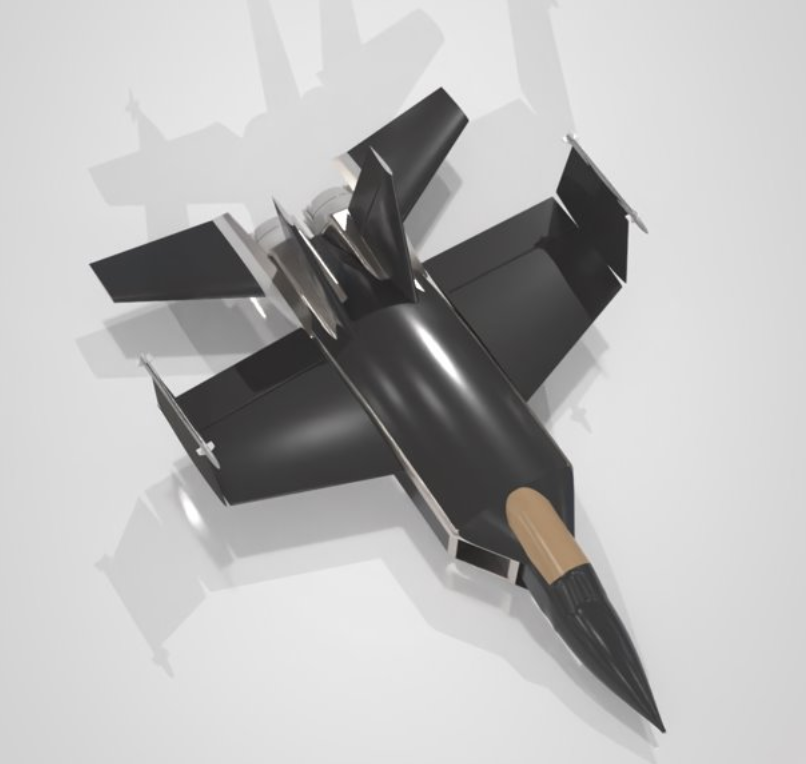
ALEBORNE F-44 Falcon — Final CAD Render
M1.84
Max Dash (30 kft)
63,464 lb
Max Takeoff Weight
60,000 ft
Service Ceiling
F119
Powerplant
Explore Aircraft View 3D Model Mission Profiles

Designed for Carrier Superiority

The F-44 Falcon is a twin-engine, carrier-based multirole strike fighter developed by Team ALEBORNE at San Diego State University in response to the 2025–2026 AIAA (American Institute of Aeronautics and Astronautics) Navy Request for Proposal. It is designed to replace the F/A-18E/F Super Hornet while remaining compatible with CVN-68 and CVN-78 class aircraft carriers.

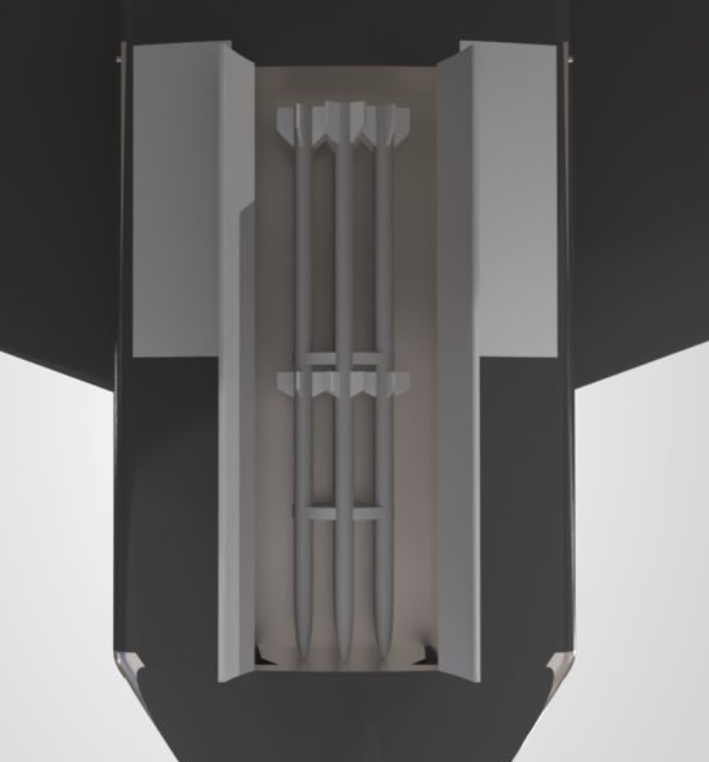
Inspired by the F-14 Tomcat, F/A-18E/F Super Hornet, and F-35C Lightning II, the F-44 incorporates an internal weapons bay for reduced RCS (Radar Cross-Section), a swept-wing planform with twin vertical tails, twin F119-PW-100 afterburning turbofan engines, folding-wing provisions, reinforced landing gear, a nose launch bar, and an arresting hook.

The design philosophy prioritizes proven subsystems (TRL 6+ — Technology Readiness Level), production-available materials suitable for a 25-year maritime service life, and cost-conscious technical maturity to support a practical 2035 IOC (Initial Operational Capability).

Carrier-Based Internal Weapons Bay Mach 1.84 Capable Twin F119 Engines Multi-Role Folding Wing 7.5g Load Factor
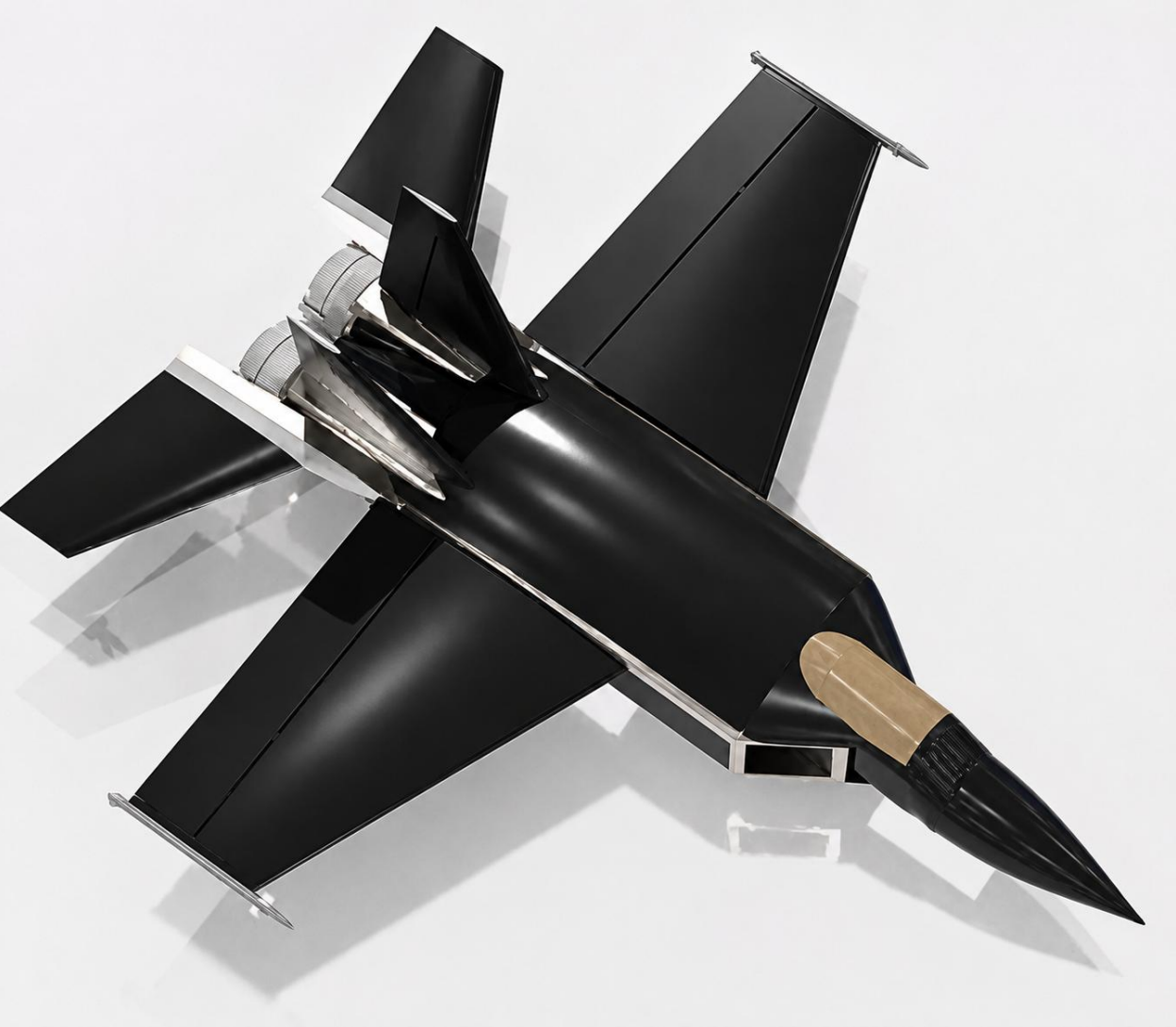
F-44 Falcon CAD Model — Side Profile

Team ALEBORNE

Seven aerospace engineering students at San Diego State University, collaborating across all aircraft design disciplines.

Maxwell O'Neill
Maxwell O'Neill
Project Manager
SDSU · AE 460
Luke Horton
Luke Horton
Performance Lead
SDSU · AE 460
Ethan Barichievich
Ethan Barichievich
Aircraft Design Lead
SDSU · AE 460
Ian Plant
Ian Plant
Structures Lead
SDSU · AE 460
William Peterson
William Peterson
Systems Engineer
SDSU · AE 460
Bryce Sullins
Bryce Sullins
Systems & Control Lead
SDSU · AE 460
Benjamin Torres
Benjamin Torres
Aerodynamics Lead
SDSU · AE 460

From Sketch to Final Configuration

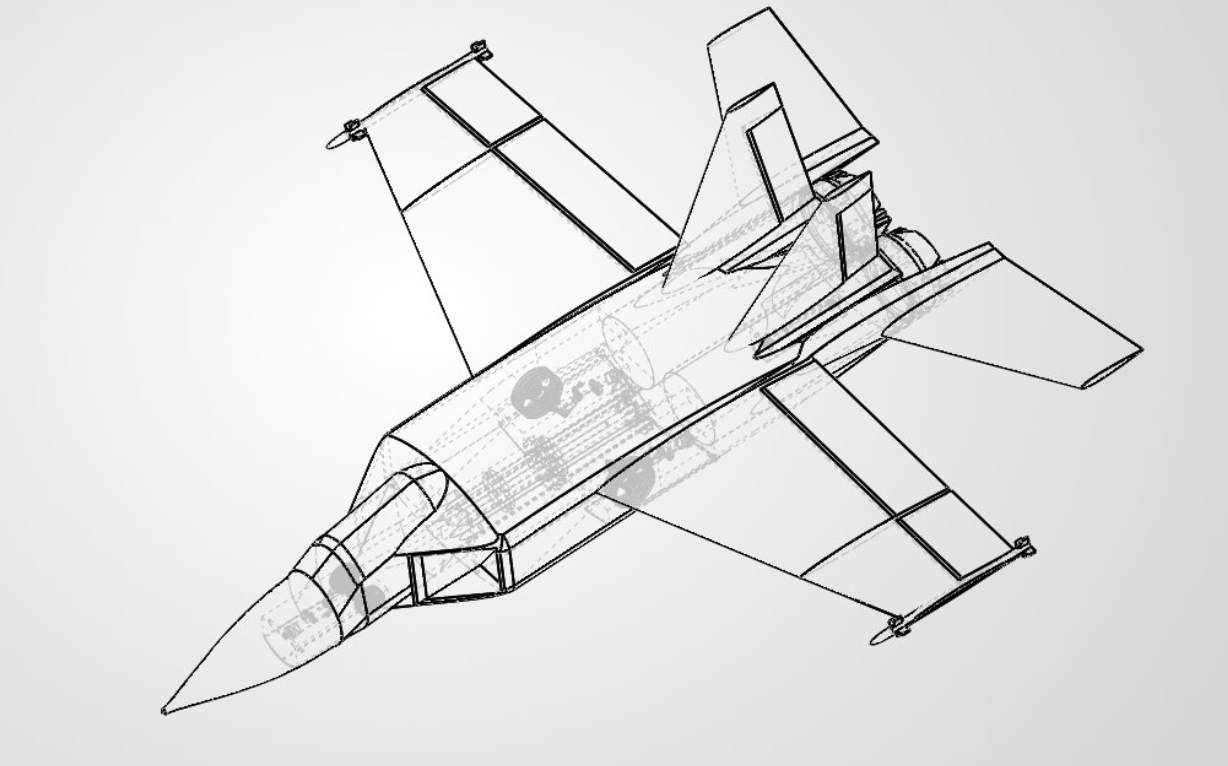
The F-44 evolved through multiple design iterations — from preliminary weight estimates and 2D sketches, through wing layout trade studies, to a finalized CAD model reflecting carrier-compatible geometry and internal payload integration.

Wing Design: The main wing features a 457 ft² planform area with a 45 ft unfolded span (35 ft folded for carrier storage), a sweep angle of 20°, taper ratio of 0.5, and an aspect ratio of 4.43. Trailing-edge flaps retract at 25% chord with 80% wing coverage and a maximum deflection of 40°.

Airfoil Selection: A dual-airfoil approach uses the NACA 65-412 at the root and NACA 65-206 at the tip, selected through a trade study balancing subsonic CL/CD (Coefficient of Lift to Coefficient of Drag), transonic performance, and supersonic efficiency. The 6% double-wedge profile was identified for maximum L/D at supersonic cruise.

Empennage: Twin vertical stabilizers (100 ft² each, 16 ft height, 46° LE sweep) provide directional stability. An all-moving horizontal stabilizer (110 ft², 19 ft span, 29° LE sweep, AR 3.28) delivers high pitch authority for maneuvering, trim, and carrier approach. Horizontal tail volume coefficient is 0.4133; vertical tail volume coefficient is 0.0766.

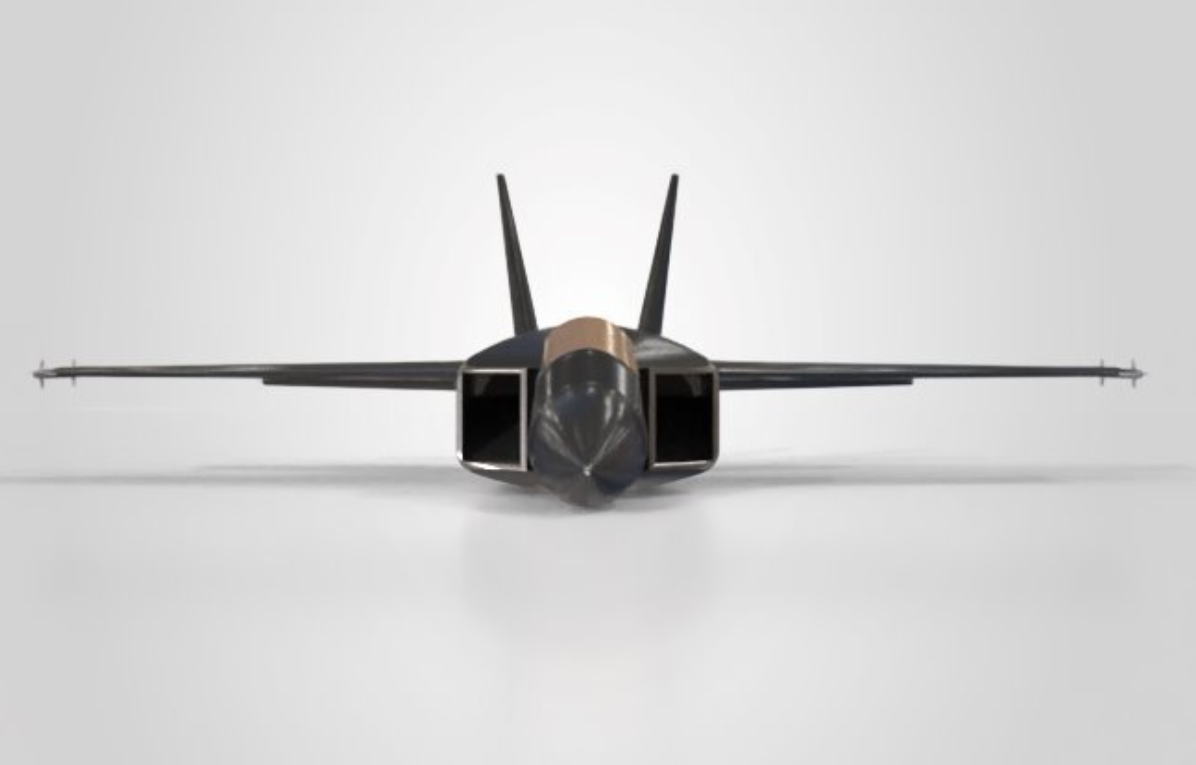
F-44 Falcon — Design Detail View

By the Numbers

Key performance parameters and geometric characteristics from the F-44 Critical Design Review (CDR).

Max Dash Speed (30 kft)
M 1.84
at 30,000 ft altitude
Max Speed (Sea Level)
M 1.22
at sea level
🎯
Combat Radius
~400
nautical miles
🛫
Service Ceiling
60,000
ft
🚬
Approach Speed
135
kn (strike config)
🚀
Catapult Launch Speed
155
knots (C13-2 catapult)
⚖️
MTOW (Strike)
63,464
lb
⚖️
MTOW (A2A)
61,600
lb
🪶
Empty Weight
~39,200
lb operating empty
💣
External Store Capacity
15,000
lb
📐
Wingspan (Unfolded)
45
ft
📏
Wingspan (Folded)
35
ft (carrier storage)
↔️
Aircraft Length
50
ft
↕️
Aircraft Height
18
ft
🔷
Wing Area
457
ft²
🔧
Powerplant
2× F119
PW-100 afterburning turbofan
📈
Thrust (per engine)
35,000
lbf afterburning / 26,000 dry
🛡️
Design Load Factor
+7.5g
/ −3.0g (MIL-A-8861B)
🛠
Endurance
3.1
hours
💰
Unit Cost (500 qty)
$78.8M
flyaway per aircraft

Twin F119-PW-100 Turbofans

The F119-PW-100 was selected through a formal engine trade study against the F404 and F414 families. The F119 provides substantially higher thrust, enabling the acceleration, climb, and sustained combat performance required by the AIAA RFP (Request for Proposal).

Each engine produces 26,000 lbf dry thrust and 35,000 lbf in afterburner, with a TSFC (Thrust-Specific Fuel Consumption) of 0.8/1.7 lb/lbf·hr (dry/AB), a bypass ratio of 0.30:1, an overall pressure ratio of 26:1, and an airflow of 250 lb/sec. Each engine weighs approximately 5,000 lb.

Rectangular inlet ducts (1,059 in² capture area) are mounted slightly off the fuselage to ensure high-momentum freestream air reaches the engine intake. The actual duct is 1.53× the minimum required area, providing margin for high-AoA (Angle of Attack) operation and future growth. Convergent-divergent afterburning nozzles maximize high-temperature exhaust flow.

F-44 Falcon — Engine Integration Detail

Built for 7.5g

The wing structure is designed for a limit load factor of 7.5g with a safety factor of 1.5, giving an ultimate load factor of 11.25g per MIL-A-8861B. At ultimate loading, the wing sustains up to 20,250 lb/ft of spanwise load distribution, 358,000 lb of shear, and 3,416,000 lb-ft of bending moment.

Wing box construction: Spar thickness of 0.52 in, spar cap thickness of 0.50 in, rib thickness of 3.397 in, and stringer cross-section of 0.75 × 0.75 in². FEA (Finite Element Analysis) was conducted using Aluminum 7075-T6 with zinc coating for corrosion resistance in the maritime environment.

The V-n diagram confirms the aircraft is maneuver-critical: gust loads at all evaluated speeds remain well below the structural limit. Maneuvering speed VA = 764 ft/s EAS (Equivalent Airspeed), with VC = 903 ft/s EAS and VD = 1,362 ft/s EAS.

F-44 Falcon — Structural Analysis View

Explore the F-44 Falcon

Rotate, zoom, and inspect the full CAD geometry. Click the play button to start the interactive viewer.

Dual-Role Capability

The F-44 is designed for two primary mission profiles per the AIAA RFP, each requiring a 700 nmi combat radius from carrier basing. Ordnance is carried for the entire mission including arrestment.

Primary Mission
Air-to-Air
Fleet Defense / CAP
Combat Radius ~400 nmi (700 req.)
MTOW 61,600 lb
Dash Speed M 1.6+ at 30 kft
Combat 2 min AB + best turn @ 10 kft
Sustained Turn Rate ~10.9 deg/s @ 20 kft

Weapons Loadout

AIM-120C AMRAAM
AIM-9X Sidewinder

Mission Phases

🚀
Launch
✈️
Cruise Out
⚔️
Combat
↩️
Return
🛬
Recovery
Secondary Mission
Strike
Deep Strike / CAS
Combat Radius ~400 nmi (700 req.)
MTOW 63,464 lb
Sea-Level Dash M 0.85+ (50 nmi dashes)
Approach Speed 135.3 kn

Weapons Loadout

MK-83 JDAM (1,000 lb)
AIM-9X Sidewinder

Mission Phases

🚀
Launch
✈️
Cruise Out
💣
Sea-Level Dash
↩️
Egress
🛬
Recovery

Launch & Recovery

Catapult Launch: Both configurations launch at 155 knots using the C13-2 catapult (306 ft stroke) at 3.17g acceleration. Assumptions: CLmax(TO) = 1.5, S = 457 ft², zero wind-over-deck, 89.8°F sea-level tropical day.

Arrested Recovery: Landing uses the Mark 7 Mod 3 arresting gear. Approach speeds are 135.3 kn (strike) and 133.3 kn (A2A) — both well below the 145 kn SRD (System Requirements Document) limit. Engagement speeds are 142.2 kn and 140.1 kn respectively. Arrestment energy is within the 90 million ft-lbf gear limit.

Landing Gear: Pre-existing reinforced gear with a nose gear catapult launch bar and retractable tailhook (shoe replaced every 10 landings). Nose gear load: 6,400 lb; main gear load: 57,600 lb. Shock absorber strokes: 19.12 in (main) and 21.57 in (nose).

Single-Engine Safety: Launch SEROC (Single-Engine Rate of Climb) is 3,735 ft/min (req: 200 ft/min). Approach SEROC is 4,127 ft/min (req: 500 ft/min).

F-44 Falcon — Carrier Operations

Requirements Compliance

Final CDR performance results against AIAA RFP requirements. The F-44 passes every requirement except combat radius, which remains the primary design limitation.

Parameter Required Desired F-44 Value Status
Combat Radius (A2A & Strike)700 nmi1,000 nmi~400 nmiFAIL
Combat Time @ 10 kft2 min5 min4.26 minPASS
Sustained Turn Rate @ 20 kft8.0 deg/s10.0 deg/s~10.9 deg/sPASS
Dash Speed @ 30,000 ftM 1.6M 2.0M 1.84PASS
Sea-Level Dash (MIL power)M 0.85M 0.90M 1.22PASS
Approach Speed< 145 kn135.3 knPASS
Design Load Factor (Nz)> 7.0g8.0g+7.5gPASS
Max Takeoff Gross Weight< 90,000 lb63,464 lbPASS
Unfolded Wingspan≤ 60 ft45 ftPASS
Folded Wingspan≤ 35 ft35 ftPASS
Overall Length≤ 50 ft50 ftPASS
Overall Height≤ 18.5 ft18 ftPASS
Launch SEROC≥ 200 ft/min3,735 ft/minPASS
Approach SEROC≥ 500 ft/min4,127 ft/minPASS
External Store Carriage≥ 10,000 lb15,000 lbPASS

Dynamic Stability

Longitudinal: The short-period mode has a period of 4.8 seconds and damps quickly, confirming rapid pitch-rate correction. The phugoid mode has a period of 95 seconds — slow and lightly damped, but stable. The all-moving horizontal stabilizer provides restoring pitching moments.

Lateral-Directional: Dutch roll is damped and oscillatory (2.6 s period). Roll subsidence is stable and non-oscillatory (eigenvalue −0.0082). The spiral mode is slightly unstable (eigenvalue +0.0080), meaning bank angle may slowly diverge without correction — this is the primary stability limitation. A fly-by-wire FCS (Flight Control System) would easily correct this in a production aircraft.

CG Travel: CG shifts as fuel is burned. At full payload/100% fuel the CG sits at 8.84% MAC (Mean Aerodynamic Chord) for strike and 9.86% MAC for A2A. The no-payload configuration shifts aft to 12–14% MAC. Landing gear mass helps anchor the CG forward.

Program Economics

Cost estimation using Nicolai methodology (adjusted to 2026 dollars). Based on a production run of 500 aircraft with 9 flight-test prototypes.

$7.35B
DT&E (Dev., Test & Evaluation)
$39.4B
Production (500 Aircraft)
$78.8M
Unit Flyaway Cost
~$46.7B
Total Program Cost

Developed as part of the AIAA Aircraft Design Competition, AE 460A/B at San Diego State University. Team ALEBORNE conducted a full conceptual design study — from mission analysis and initial sizing through aerodynamics, propulsion, structures, stability & control, and life-cycle cost estimation — delivering a complete aircraft design ready for preliminary design phase. Faculty advisor: Professor Geoffrey Butler.

7 Team Members
142 Page Final Report
2025–26 AIAA Competition
SDSU San Diego State Univ.